Abdullah Al-Qasemi (1907–1996) is one of the most controversial intellectual figures in modern Arab thought (e.g., Al-ʿArabiyya, 2016). This essay reconstructs a neglected conceptual structure in Al-Qasemi’s thought: critique not as negation, but as a transformed mode of relation.
Existence as Imposition
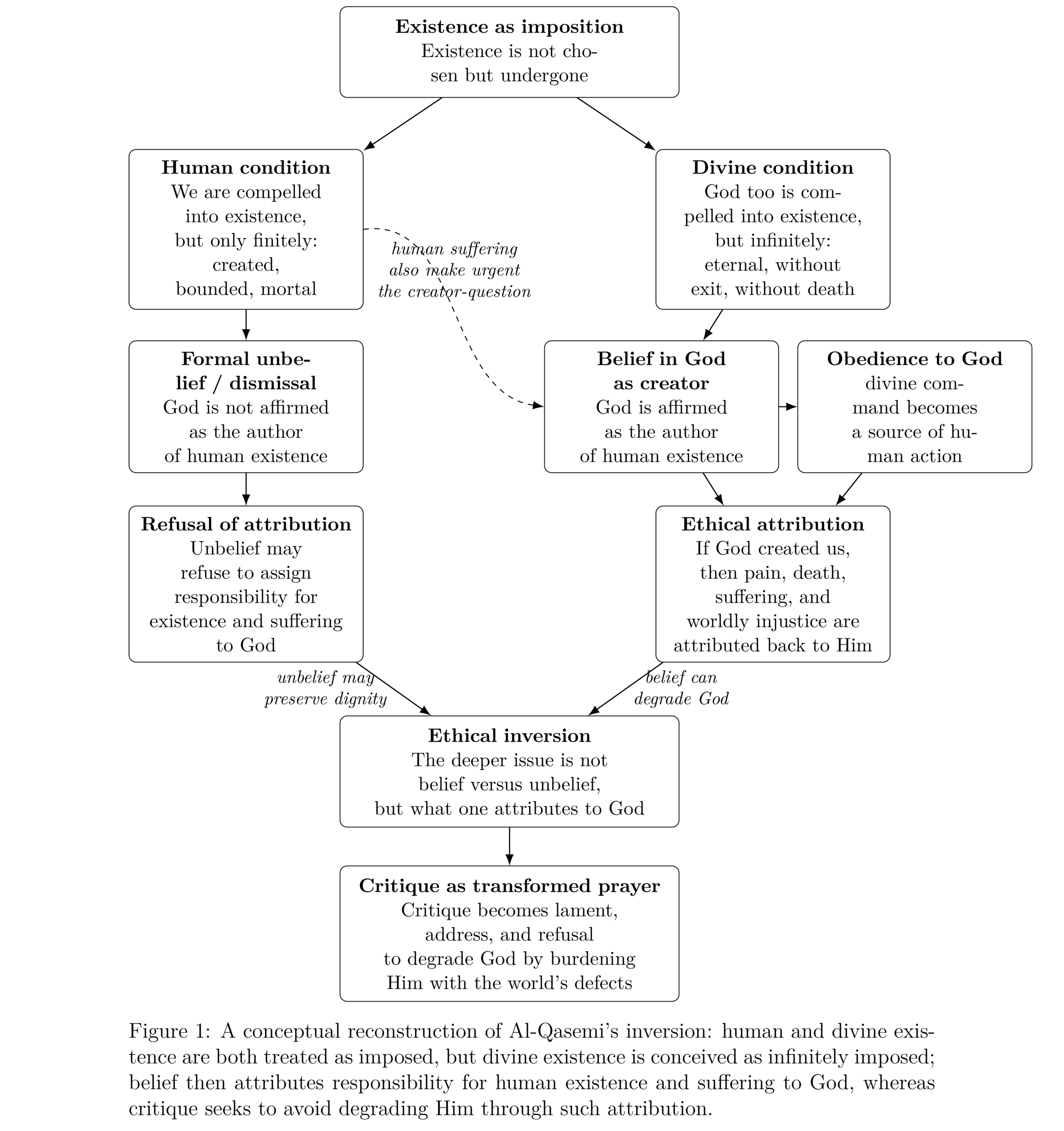
For the Saudi thinker who is often dismissed as atheistic (e.g., Arahal, 2023; Al-Afrīqī, 2014), the starting point is not belief, but imposition. We were not given a choice to be human rather than flies, nor were flies given the choice to be human (Al-Qasemi, 2003, p.16). Like a worm condemned to live, suffer, and die in the “depths of the soil,” we too are compelled to exist, with all our deformities, flaws, deficiencies, and resentments, in a form we did not choose, within a world we did not choose.
From this starting point, Al-Qasemi asks (Al-Qasemi, 2001, p. 70):
Are humans freer than fleas? Humans speak of freedom without fleas, but do they live freedom more than fleas do?
هل حرية البشر أكثر من حرية البراغيث؟ إن البشر يتحدثون عن الحرية دون البراغيث، ولكن هل يعيشون الحرية أكثر مما تعيشها البراغيث؟
Across his writings, Al-Qasemi develops this idea further into a radical symmetry: if human existence is imposed, then the God humans believe in must also be understood through the same logic. He exists without having chosen existence; he is eternal and cannot die. If eternity is necessary, then it is also imposed. God, therefore, is exiled within existence, both bound to it and unable to escape it.
In this view, God, like the rest of us, is understood as compelled into being. And this, for Al-Qasemi, is among the most troubling and unacceptable conditions imaginable (Al-Qasemi, 2003, p. 13) and God, as conceived by humans, is rendered in Al-Qasemi’s account as the most unfortunate of beings. Thus, existence itself is stripped of its moral grandeur
Existence is not always heroism, gain, or victory (Al-Qasemi, 2002, p. 328).
.الوجود ليس دائماً بطولةً أو ربحاً أو إنتصاراً
Belief as a Form of Degradation
Within classical Islamic moral discourse, obedience is not merely compliance but the primary expression of fidelity to God, often encapsulated in the formula “we hear and we obey” (Q 2:285). This relation between love and obedience is made explicit in verses attributed to Imam al-Shāfiʿī:
You disobey God while you profess His love this, in sound reasoning, is an impossible claim.
If your love were true, you would obey Him for the lover, to the one he loves, is obedient.
تَعصي الإِلَهَ وَأَنتَ تُظهِرُ حُبَّهُ هَذا مَحالٌ في القِياسِ بَديعُ
A further inversion within the tradition complicates the association between love and obedience. In one such account, preserved in Sufi literature and associated with al-Hallāj, Iblīs’ refusal to prostrate is reinterpreted not as mere defiance, but as a claim to exclusive devotion. In one such account, in Sufi literature, including narratives associated with al-Hallāj, when asked why he refused to prostrate, Iblīs replies: “What prevented me was my claim to a single Beloved [God]. If I had prostrated to him [Adam], I would have become like you. You were called once to ‘look at the mountain,’ and you looked. I was called a thousand times to prostrate, and I did not prostrate, because of the meaning of my claim.” Here, disobedience is no longer a failure of love, but its radicalization. The refusal to obey is framed as fidelity to a higher form of devotion, thereby placing pressure on the assumption that obedience itself guarantees moral or spiritual integrity.
Al-Qasemi’s critique draws on this familiar moral grammar found in classical Islamic discourse. He argues that believers, in defending God’s existence and especially in obeying His commands, may in fact degrade Him by attributing to Him the errors, deficiencies, and injustices of the world (Al-Qasemi, 2002, p. 23). They project onto Him not only their own flaws, but also the flaws of existence itself, assigning responsibility where there was no choice (Al-Qasemi, 2002, p. 295). Al-Qasemi makes this inversion explicit in passages where he rejects being read simply as a denier of God. In an introductory chapter titled “You Cannot Be an Atheist,” he insists that doubt does not constitute the deepest form of denial. Rather, those who profess belief while attributing injustice, error, and moral failure to God are, in his view, more fundamentally in contradiction with Him: “If I had claimed otherwise, I would be in satire [belittling] of God” (Al-Qasemi, 2002, p. 16). Al-Qasemi thus reconfigures both obedience and disobedience. In this sense, belief combined with either obedience or disobedience produces the same structural outcome: a displacement of responsibility for evil away from the human agent and onto God.
He makes this ethical inversion explicit:
“I hope that Arabs believe in a God that blesses freedom and intelligence, even if both meant denying Him, and [a God] that abhors surrender and impotence, even if both meant believing in Him… I wish man the morals of the stars, even in denial of all the gods, and I refuse to him the morals of insects in devout faith of all the gods” (Al-Qasemi, 2002, p. 16).
Here, belief and disbelief are no longer defined by formal affirmation, but by the ethical consequences attributed to God, placing responsibility not on belief itself, but on what one affirms in God’s name. What appears as unbelief may preserve divine dignity, while what appears as belief may degrade it. Thus, Al-Qasemi’s critique does not simply deny God; it redefines belief by shifting it from formal affirmation to ethical attribution.
This inversion intersects with a familiar theological tension: if God is affirmed as just, the attribution of injustice to Him becomes morally charged. For Al-Qasemi, the contradiction is not merely theoretical. It is enacted in obedience. To believe while attributing injustice to God, even if one arbitrarily defines justice as anything willed by God, is to accept commands that one would otherwise condemn, and to carry them out in His name. In doing so, they act not as agents of their own judgment, but as instruments of a responsibility displaced onto God. The contradiction, then, is not between belief and disbelief, but between moral judgment and obedience performed under divine attribution.
I refuse to die, for my son to die, for my friend to die, for any human to die, for my enemy to die, for me to have an enemy! I refuse that under any slogan, under any idea behind which hide the greatest lies and the most monstrous tyrants and teachers. Therefore, I refuse the teachings and doctrines that teach me how to be a killer, how to be killed, how to believe in that, how to chant for those who call me to it, those who would lead me into it.
أنا أرفض أن أموت، أن يموت أبني، أن يموت صديقي، أن يموت أي إنسان، أن يموت خصمي، أن يكون لي خصم! أنا أرفض ذلك تحت أي شعار، تحت أي فكرة تختفي وراءها أضخم الأكاذيب وأفجر الطغاة والمعلمين، لهذا أنا أرفض التعاليم والمذاهب التي تعلمني كيف اكون قاتلاً، كيف أكون مقتولاً، كيف أؤمن بذلك، كيف أهتف لمن يدعونني إليه، لمن يوقعونه بي.
Al-Qasemi illustrates this through stark analogy (Al-Qasemi, 2002, p. 28):
One [the believer] is like someone who sees you, curses you, and exposes himself before you in defiance; the other [the unbeliever] is like someone who does not see you, does not respect you, or does not need to respect you because he does not see you.
كالذي يراك ويلعنك، ويتعرى أمامك متجرئاً عليك؛ وأن الثاني كالذي لا يراك ولا يحترمك، أو لا يحتاج إلى أن يحترمك لأنّه لا يراك
For him, the believer who violates divine commandments resembles:
one who commits an obscenity with his mother in the Kaaba,
كمن يأتي الفاحشة مع أمه في الكعبة
whereas the non-believer resembles:
one who does so with a stranger in his own home (Al-Qasemi, 2002, p. 28).
كالذي يأتيها مع أجنبيةٍ في بيته
In this inversion, and in tension with the familiar Muslim doctrine that “Every son of Adam sins,”1 Al-Qasemi asks:
Who, then, is more unjust toward God than the believers themselves?
فمن أظلم إلى الله أكثر من المؤمنين به؟
Critique as a Form of Prayer
Al-Qasemi ultimately refuses both submission and insult. He “dismisses” God from existence, not out of hostility, but as a refusal to hold Him accountable for the defects of the world (Al-Qasemi, 2002, p. 327). He does not wish to curse Him, nor to violate His teachings in His name. Instead, he chooses critique.
Critique, in Al-Qasimi’s view, does not destroy what is strong; it exposes what is weak. Things perish, he emphasizes, not because of critique, but because of their weakness.
The freedom to critique religions and values will not weaken either, and forbidding their critique will not bestow them vigor and persistence (Al-Qasemi, 2002, p. 15).
Importantly, for Al-Qasemi, critique is not indifference but intensity, signaling involvement, not distance:
We criticize something in proportion to how we feel about it, in proportion to its impact on us.
.ننقد الشيء بقدر شعورنا نحوه، بقدر ما له من تأثير علينا
Critique, then, is not rejection, but recognition:
Criticism is always a sign of appreciation.
.هو دائماً علامة تقدير
In this sense, his critique of God assumes a paradoxical spiritual form:
a form of prayer, spoken in a language stronger than all the languages of temples (Al-Qasemi, 2003, p. 15).
.يصلّي [له] بلغةٍ هي أقوى من كلّ لغات المعابد
Synthesis
This characterization is not merely interpretive. Al-Qasemi himself describes his critical writings as “a kind of prayer and weeping,” insisting that even rebellion and defiance constitute a more sincere form of prayer than that of formal religious expression (Al-Qasemi, 1963, p. 578). What appears as accusation or harshness is thus reframed as lament: “he is weeping, not cursing,” and “his critique is nothing but an elegy for the world… a tearing of the self (Ibid.).” In this light, critique does not negate prayer but transforms it. It preserves the structure of address, to God, to the universe, to humanity, while stripping it of submission and consolation, a move echoing what Camus describes as revolt that refuses rupture while sustaining confrontation (Camus, 1951), and, in a different register, what Kierkegaard identifies as a form of relation preserved even in despair (Kierkegaard, 1849). Al-Qasemi’s critique, then, while converging with certain existentialist formulations, emerges from an internal reworking of Islamic moral and theological discourse. It does not mark a rupture with the divine, but an intensification of relation through suffering, not submission.
A Note on Methods
Rather than treating Al-Qasemi’s terms as stable, this reading follows his own vocabulary across texts, tracing how concepts such as prayer, belief, and critique are transformed and reassigned new functions within his thought. The transliteration “Al-Qasemi” is adopted for consistency with common English-language usage; variant spellings are preserved where they appear in cited titles.
Closing Note
This brief synthesis is not intended as an endorsement of Abdullah Al-Qasemi’s conclusions, but as an attempt to recover the internal logic of his thought as his writings often circulate in fragments. While his work is largely absent from formal curricula and systematic study, it persists in decontextualized forms, mainly selected quotes, across popular media. Even where English-language scholarship and polemical online discourse have addressed Al-Qasemi, the tendency has often been to foreground apostasy, atheism, and biographical rupture, often framed through broad references to “Western thought”, rather than sustained reconstruction of the internal conceptual structure of his work (e.g., Arahal, 2023; Al-Afrīqī, 2014).
Reading him across texts suggests a more coherent epistemic move centered on the notion of imposed existence and the collapse of the assumed ontological asymmetry between human and divine conditions. In this sense, revisiting Al-Qasemi is less about agreement or disagreement than about confronting a form of thought in which critique does not signal detachment. Instead, what emerges is an inescapable entanglement with what it opposes, a relation he himself anticipated would be misread and reduced to its most visible expressions (Al-Qasemi, 1963, p. 579).
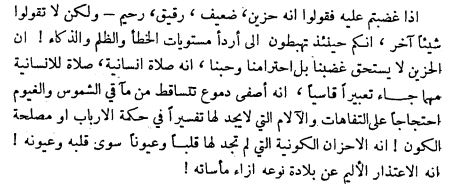
Coda (from the chapter “Ṣalāt” [Prayer], Al-Qasemi, 1962)
If you wish to condemn him, then say: he is sad, weak, gentle, and merciful—but do not say anything else; otherwise, you descend to the lowest levels of error, injustice, and ignorance. The sad one does not deserve our anger, but our respect and love. He is a prayer of humanity, a prayer for humanity, however he appears as a harsh expression. He is the purest of tears falling from the canthi of the suns and the clouds in protest against the trivialities and pains that he cannot find an explanation for, both in the wisdom of the gods, and in the utility of the universe! He is the cosmic sorrows that found no heart and eyes but his own heart and eyes. He is the painful apology for the apathy of his kind in the face of his tragedy!
Notes
Examples of sources for the Hadith include Sunan al-Tirmidhi 2499 & Ibn Majah 4251 ↩︎
References
Primary texts by Al-Qasemi are listed alongside secondary literature and contextual sources in alphabetical order.
Arahal, S. (2023). Abdullah Al-Qassemi: The Arab embodiment of Western thought. Journal of Culture, Society and Development, 71, 48–52. https://doi.org/10.7176/JCSD/71-06
Camus, A. (1951). The Rebel (L’Homme révolté). Gallimard.
Kierkegaard, S. (1849). The Sickness unto Death (Sygdommen til Døden).
Leave a Reply